Rue Des Tournelles Paris Apartment for Rent Art Nouveau Nyc Owner

Castel Beranger, the starting time Fine art Nouveau apartment building in Paris
The Castel Béranger is a residential building with thirty-six apartments located at 14 rue de la Fontaine in the 16th arrondissement of Paris. It was designed by the architect Hector Guimard, and built between 1895 and 1898. It was the first residence in Paris congenital in the manner known as Art Nouveau.
History [edit]
Architect Hector Guimard (1867-1942) was born in Lyon and attended the School of Decorative Arts and the École des Beaux-Arts in Paris. He was in charge of the construction of the Pavilion of Electricity at the 1889 Paris International Exposition, and between 1891 and 1893 he congenital several private houses and a school in Paris, all in the traditional styles.
In 1894, at the age of twenty-seven, Guimard traveled to England and to Belgium, where he met the Belgian builder Victor Horta, and saw the Hotel Tassel which Horta had built in 1893–94 in what later became known as the Art Nouveau style. It was inspired not by classical models but by nature, particularly by the curving stems of plants and flowers. Horta also stressed to Guimard the importance of unity in a building; the structure, decoration, article of furniture, wallpaper, carpets and ornamentation should all go together.[1]
Guimard had undertaken the project of designing an flat building in a traditional way for a widow named Madame Fournier earlier he went to Brussels and met Horta. When he returned, he persuaded his customer to let him to build the construction in the new style. He began designing the Castel Béranger in 1895, Guimard became involved in every item of the projection, designing the furniture, ornamental ironwork, carpets, glass, wall paper, door locks and doorknobs.[1]
Guimard did non forget his debt to Horta; when the building was done, Guimard sent him an anthology of the designs of the building with the inscription, "to an eminent chief and friend, Victor Horta, affectionate homage from an admirer."[2]
The design [edit]
Describing the Castel Béranger, the architectural historian and critic Simon Texier wrote: "The Art Nouveau had every bit its characteristic trait a naturalist arroyo, which made a building or a simple object into a work which was at the same time complex, in movement, and unified by its lines."[3]
At that place were many elements of the new building that were neo-Gothic, though Guimard's estimation was very far from the pure 13th century style advocated by Viollet-le-Duc. It was suggested by the name Castel, rather than Hotel, and by its modern version of echauguettes, the overhanging turrets that were a feature on the corners of medieval castles.[four]
Guimard put into the edifice a multiplicity of different forms, materials and colors, some of them inspired past the colors of the villas of seaside towns. The ornament was abundant, simply carefully designed and not overwhelming; it moved abroad from Gothic into a more personal and original manner. The interior decoration was also diverse and personal.[four]
-

Gateway
-

Archway hall
-

The entrance hall
-

Balcony decoration
-

Corner detail
-

Outside ornament
-
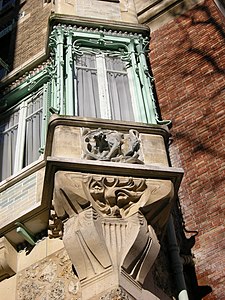
Window decoration
-
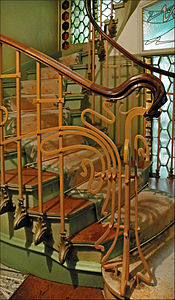
Particular of main stairway
-

Window facing the courtyard
-

Fountain in the interior courtyard
-

Facade particular
The Paris facade competition [edit]
In the tardily 1890s, there was growing criticism of the identical facades of the buildings along the Paris boulevards built during the Second Empire of Napoleon III and his prefect of the Seine, Georges-Eugène Haussmann; they were described as monotonous and boring. In 1898 the City authorities encouraged variety by organizing a competition for the nigh beautiful and original new edifice facades; the winner for the 16th arrondissement was Guimard's Castel Béranger. In the same year, Guimard was selected to design the entrances of the new stations of the Paris Metro, making him the nigh prominent figure in the French Art Nouveau.[i]
Guimard too took the step, unusual at the fourth dimension, of launching a public relations entrada based on the building, promoting the new style as a footstep forward. It was the get-go time that an builder treated a simple residential building as a major work; in the 20th century this became 1 of the characteristics of the modernist revolution in architecture.[4]
Afterwards [edit]
Guimard built i other Art Nouveau house in Paris; his own residence, the Hotel Guimard, betwixt 1909 and 1913, at 122 Artery Mozart. For his own business firm, he moved away from decoration and expressed the Art Nouveau idea of modeling after nature in the class of the building itself. Beside the Metro station, Guimard's other Paris works included a Theater/Concert Hall, the Salle Humbert de Romans, which was opened in 1901 and demolished in 1905, and the Synagogue on Rue Pave in the Marais (1913).
Between World War I and World War II Guimard turned his attending to experiments in edifice houses with prefabricated materials, including bricks of molded concrete, covered with a glaze (enduit) molded metal windowframes, and a roof covered with zinc. In 1922 he congenital a house on foursquare Jasmin with these materials. In 1930 he designed a country house, la Guimardiere, where the pipes for the plumbing became a decorative element, featured on the exterior, a precursor of the Center Pompidou. Information technology was demolished in 1969. As Globe War II approached, he left France and died in New York in 1942.[one]
Virtually all of his Metro stations were removed, and he was nearly forgotten as an architect until the 1970s, when there was renewed involvement in the Art Nouveau. The Castel Béranger was classified as an historical monument on 3 July 1972.
Run across also [edit]
- Art Nouveau
- Paris architecture of the Belle Époque
References [edit]
Notes and citations [edit]
- ^ a b c d Lahor 2007, p. 139.
- ^ Texier 2014, p. 112. sfn error: no target: CITEREFTexier2014 (help)
- ^ Texier 2014, p. 110. sfn mistake: no target: CITEREFTexier2014 (help)
- ^ a b c Plum 2014, p. 38.
Bibliography [edit]
- Fierro, Alfred (1996). Histoire et dictionnaire de Paris. Robert Laffont. ISBN2-221-07862-four.
- Lahor, Jean (2007). L'Art Nouveau. Baseline Co. LTD. ISBN978-1-85995-667-0.
- Plum, Gilles (2014). Paris architectures de la Belle Époque. Éditions Parigramme. ISBN978-2-84096-800-nine.
- Renault, Christophe (2006). Les Styles de 50'architecture et du mobilier. Editions Jean-Paul Gisserot. ISBN978-2-877474-658.
- Texier, Simon (2012). Paris Panorama de l'architecture de l'Antiquite a nos jours. Parigramme. ISBN978-2-84096-667-viii.
Coordinates: 48°51′09″N 2°sixteen′29″E / 48.8524°North two.2746°E / 48.8524; 2.2746
zimmermannancterionts1956.blogspot.com
Source: https://en.wikipedia.org/wiki/Castel_B%C3%A9ranger
0 Response to "Rue Des Tournelles Paris Apartment for Rent Art Nouveau Nyc Owner"
Enregistrer un commentaire